The EE Department implemented a completely revised curriculum in 1995. Core (required) courses in the new curriculum include a course in Energy Conversion with a laboratory and a course in Power Systems. Those students choosing to specialize in Energy Conversion and Power Systems will take two additional electromagnetic energy conversion courses with laboratories, two power systems courses, and a senior design sequence of three courses and/or additional courses including transformer design, distribution engineering, or building electrical design.
The graduate and undergraduate programs both emphasize power systems, with dielectric materials a second major area of interest at the graduate level. Course work and research also cover power electronics and electric machines. The department has made a conscious decision to concentrate its efforts on power systems, where we graduate power engineers best suited for electric utilities, engineering/architectural consultants, large power users, and utility equipment suppliers. These graduates reflect the expertise of the department, which includes capabilities in protection, operation, and control of power systems; a knowledge of theory and use of commercial packages for fault, power flow, and transient studies; and a fundamental knowledge of power system components including transformers, rotating machines and circuit breakers.
Topics of graduate level courses include computer methods in power systems, power system stability, transient surges in power systems, high voltage engineering, industrial electronics, and current topics in electric power. Research interests and capabilities of the power faculty at MTU include insulating materials, power system transients, transformer modeling, FACTS and HVDC systems, harmonics and power quality, power system stability, relaying, computer modeling of power systems, energy conversion, high voltage engineering, and the development and application of computer techniques to the design and operation of power systems.
The MTU power program has a long history of support from the university, its alumni, and from our industrial partners. Industry's support is particularly important in maintaining program quality. Over the last ten years, the power program at MTU has received over $1 million in program support from industry. This is in addition to sponsored research.
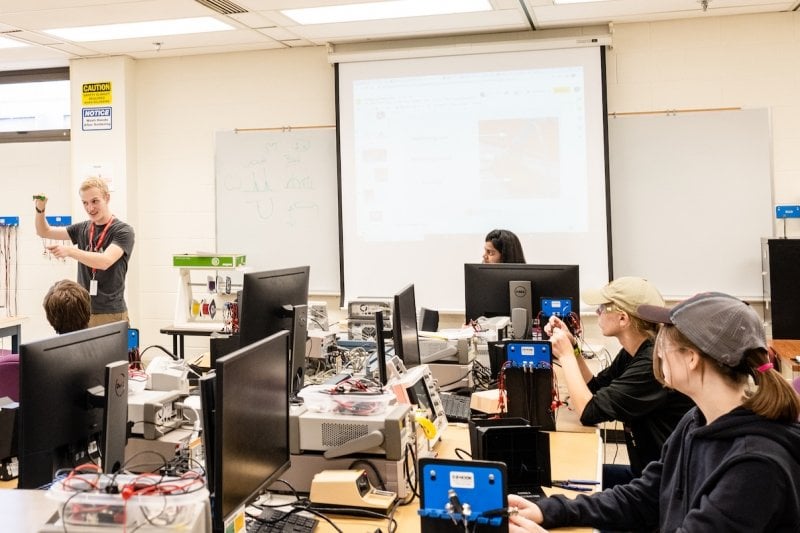
Michigan Tech has one of the finest physical facilities for electrical engineering in the U.S. The department occupies 50,000 square feet in the Electrical Engineering Resources Center. This space includes nine laboratories devoted to instruction and research exclusively in the power area: an energy conversion laboratory, a high-voltage laboratory, a power computing laboratory and a recently added transformer testing laboratory.
This page maintained by ljbohman@mtu.edu