Fall 2003
![]() Connecting the Department of Electrical and Computer Engineering with alumni, students, and faculty. |
|
PhD student earns fellowship PhD student Melissa Trombley received a National Defense Science and Engineering Graduate Fellowship to perform research in the field of microelectromechanical systems, primarily focused in the area of inertial sensors. She is developing microsystem fabrication technologies to further the integration of mechanical and electrical components. Melissa's PhD advisor is Professor Paul Bergstrom. Professor elected as society Fellow Professor Michael Roggemann has been elected to the grade of Fellow by International Society for Optical Engineering. Fellows are distinguished individuals who have made significant scientific and technical contributions in optics and optoelectronic. The society was founded in 1955 to bring together engineers from several technical disciplines involved in high-speed, optically based test and measurement. Roggemann is also a Fellow of the Optical Society of America. Department of Electrical and Computer Engineering Michigan Technological University 1400 Townsend Drive
|
|
| Greetings from Houghton! | ||
|
We have established a new format for our newsletter that we hope will allow us to connect more frequently and reliably with our alumni and friends. Each newsletter will give you an update on the ECE department's students, faculty, and alumni. We are very proud to have the nation's first - and the world's second - IEEE Women in Engineering student group. The founders of this group, Maggie Ledebuhr and Wing Kam Li BSEE '03, were recognized as the 2002-03 Department Scholar and Outstanding Undergraduate Student, respectively. Hats off to Maggie and Wing! Our May 2003 graduating class included the first students to receive |
the
Bachelor of Science in Computer Engineering at Michigan Tech. And in addition
to the steady growth in student numbers shown by this program, enrollment
in our PhD program has tripled in recent years and graduate enrollment in
general is nearing an all-time high. Several vital and exciting research
programs are ongoing in the department. The recent selections of Gerry Tian
and Brian Davis for the National Science Foundation's CAREER Award bring
the department's total to four. |
And Paul Bergstrom and Ashok Goel have just initiated a $1.5 million DARPA project to develop a center for nanomaterials research. I hope you will enjoy this brief update from the department, and I hope you will be able to take a few minutes to update us on any recent developments in your life. You can return the form included in this newsletter, or drop me a note at schulz@mtu.edu. And anytime you are in the area, please drop by the department and take a few minutes to visit with our faculty and staff. We would love to see you. Best wishes, Tim Schulz ECE department chair |
| Alumnus joins Tech’s Board of Control | ||
| The Michigan Tech Board of Control chair says his degree in electrical engineering propelled him to head one of the nation's largest electrical construction companies. David Brule, who earned his BS in 1972, is the former CEO of M. J. Electric, based in Iron Mountain, Michigan. “The advantage received from a Michigan Tech electrical engineering education is a highly developed ability to analyze and solve problems that aren't in the text books but occur every day in the business world,” he said. Brule said this ability comes from the strong emphasis placed on math, physics, and chemistry, which every electrical engineering student is required to master before upper level electrical theory. “It's not so much the subject matter of these classes as it is the thinking process. In addition, Michigan Tech fosters and rewards a strong work ethic because it's a demanding institution with high standards,” he said. |
Brule
is a native of Norway, Michigan. He began his professional career with Wisconsin
Public Service. He joined M. J. Electric in 1973 as a project engineer,
was elected executive vice president in 1985, and became the president and
CEO in 1990 and majority stockholder in 1992. Under his leadership, M. J.
Electric became one of the nation's largest electrical construction companies
and a leading manufacturer of specialty snow removal equipment through its
BOSS Snowplow product line. Brule sold the construction operations to Exelon
Infrastructure Services in December 2000, retaining the manufacturing portion
of the business, which is headquartered in Iron Mountain, Michigan.
|
In addition to
serving on many electrical industry boards and committees, Brule is a founding
member of the Electri'21 Council, a construction industry "think tank,"
where he was chairman of the Committee on the Future of the Electrical Construction
Industry as well as the Electrical Construction Roundtable, an organization
of electrical contractors dedicated to the improvement of each member's
business using the technique of “bench marking.” In April of
1996, David was elected a Charter Member of Michigan Tech's Electrical Engineering
Academy in recognition of his excellence and leadership in engineering and
civic affairs. In April of 2000 he was presented a “Lifetime Achievement
Award in Construction” by the University of Wisconsin. Brule was appointed
to the Board of Control in April 2001 for a term that expires in December
2008. He was elected chair during the May 2002 meeting and again in May
of 2003. David and his wife, Elsa, reside in Iron Mountain. They have four
children and six grandchildren. |
| Assoc. professor writes naval grant | ||
| Warren Perger, an associate professor in the ECE department, is collaborating with researchers at Washington State University and Massachusetts Institute of Technology in an Office of Naval Research grant to understand how deformations in certain crystals ultimately lead to the initiation of a shock and, consequently, a detonation. | Researchers at Washington State are performing infrared, raman, and optical absorption studies of energetic crystals; MIT is performing femto-second resolution experiments of the shock-to-detonation transition. Perger is computing predictions for these phenomena. "I try to predict the properties of these rather complicated explosive organic molecular crystals, both at ambient and non-ambient pressures, with static experiments," he said. | Perger is studying where various chemical bonds within and between the molecules break, release energy, and break other bonds. "The details of this process are completely unknown," he said. Perger and his colleagues are running static theory tests with experiments at Washington State and MIT. |
| ECE professors work on Air Force project | ||
| Department Chair
Tim Schulz and Professor Michael Roggemann have teamed up with three other
universities to conduct a research project. With help from the University
of California Los Angeles, the Air Force Institute of Technology and Georgia
Tech, the Michigan Tech professors are working on an Air Force Office of
Scientific Research project. |
Roggemann said dramatic improvements
in laser power and wave front control technology for space surveillance
and laser antisatellite and anti-ballistic missile weapons have given rise
to DoD interest in extensions and alternative uses of this technology. Their
main interest is directed on energy weapons, such as lasers, which can also
operate in a "lookdown, shoot-down" mode to inflict damage on enemy targets.
"The agility and speed combined with potential pinpoint accuracy and low
collateral damage arising directly from the weapon makes laser weapons highly
desirable," |
Roggemann said. The major technological
barrier, which must be resolved to bring these weapons to maturity, is the
ability to deliver energy to the target through the atmosphere in all scenarios
of interest, from high altitude airborne lasers to low altitude tactical
battlefield scenarios. |
![]() General Motors Co. presented a GM Managed Partnership worth $175,000 to Michigan Tech on May 2. GM also sponsors an annual Student Design project for the Department of Electrical and Computer Engineering. |
Profs. receive NSF award Two ECE assistant professors earned the National Science Foundation's Faculty Early Career Development (CAREER) award. Brian Davis earned one in 2002, and Zhi (Gerry) earned hers in 2003. The CAREER program recognizes and supports the early careerdevelopment activities of those teacher-scholars who are most likely to become academic leaders of the 21st century. This program emphasizes the importance the foundation places on the early development of academic careers dedicated to stimulating the discovery process. |
|
| Four join ECE department’s faculty | |||
![]() Chunxiao (Tricia) Chigan |
![]() Luc Gilles |
![]() Jindong Tan |
![]() Seyed Zekavat |
| Chunxiao (Tricia) Chigan joined
the ECE department as an assistant professor in August 2002. Prior to Tech,
Chigan worked as an intern member of technical staff and visiting scholar
at Bell Labs, Lucent Technology in Holmdel, New Jersey. Chigan said she
is attracted to Tech for two reasons. "I like this close-to-nature environment;
Houghton- Hancock are very quaint, and our department has very good supportive
system for young faculty career development," she said. Chigan previously
taught communication networks for graduate and undergraduate students. She
earned a PhD in electrical engineering from State University of New York
at Stony Brook in 2002. "Compared to other schools with the same rank, we
have very good lab facilities and the faculty members are very friendly
and helpful," she said. Her research interests include design of dependable
computing and communication systems, cross-layer network design, fault and
security tolerant, wireless network security, network protection, and Ad
Hoc and sensor networks. Chigan's hobbies include hiking, cooking, writing,
and cultural events. |
Luc Gilles, 36, is an assistant
professor in the department. Gilles joined the department in 2002 after
working as a research associate at Montana State University. He earned a
PhD in physics from the University of London's Imperial College in 1993.
Gilles said he's liking his new surroundings and his fellow faculty members.
"I hope to develop a stronger student interest in optics at Michigan Tech,"
he said. " Graduate students with the necessary background in optics to
help me with my research are difficult to find." Gilles, a native of Brussels,
Belgium, has taught Fourier optics, digital image processing, and optical
information processing. He is teaching adaptive optics techniques and optical
information processing this year. Gilles's principal research areas concern
the analysis, modeling, and simulation of adaptive optics systems and digital
image processing techniques. Gilles's recent publications in journals tackle
topics in "Computational Methods for Large-Scale Inverse Problems arising
in Atmospheric Optics." His hobbies in clude swimming, traveling and studying
general science. |
Jindong Tan, 33, is an assistant
professor in the ECE department. Tan comes to Michigan Tech from Northeastern
University in China, where he worked as an assistant professor. "I came
to Tech since I love teaching and doing research," he said. "I enjoy working
with the ECE faculty." Tan earned his PhD in electrical and computer engineering
from Michigan State University in 2002. At Michigan Tech, he has taught
digital logic and computer applications in robotics for graduate students.
He is teaching embedded sensor networks and digital logic this year. Tan's
areas of research are in embedded sensor networks, digital logic, mobile
wireless sensor networks, and robots and human machine interaction. Tan's
most recent publication is "Coordination of Human and Mobile Manipulator
Formation in a Perceptive Reference Frame" and "Integration of sensing,
computation, communication and cooperation for distributed mobile sensor
networks," accepted by IEEE International Conference on Robotics, Intelligent
Systems and Signal Processing in 2003. His hobbies include swimming, fishing,
and jogging. |
Seyed Zekavat, 37, is an assistant
professor in the ECE department. Zekavat earned his PhD in electrical and
computer engineering from Colorado State University in 2002. Zekavat has
taught wireless communications, statistical signal processing, digital signal
processing, radar theory, electric circuits, and logic circuits. He is teaching
statistical signal processing this year. "I came to teach at Michigan Tech
for it's reputation, and its calm, beautiful and safe environment," he said.
"I also enjoy the lovely people at Michigan Tech and in the community."
His current areas of research include spectral sharing and allocation, Orthogonal
Frequency Multiple Access systems, smart antennas, adaptive beam forming,
and channel modeling and estimation. He has a patent pending for an Active
Radar Based Vehicle Safety Early Warning System, requested in May 2003.
Zekavat's has contributed to a chapter in a book, "Adaptive Antennas Array
Techniques," which will be published in 2004. He has published more than
thirty technical papers. His hobbies are swimming, ping-pong and traveling.
|
| Design
projects benefit students |
Companies get involved |
| The ECE Senior Design program
is on track to be the nation's best. Based on survey and anecdotal data,
Dave Stone, Senior Design coordinator, said that he is confident that Tech
is already easily in the top ten. "We work hard to put every senior in the
program onto an industry-sponsored project," Stone said. In the last two
years the ECE department has executed thirty-four Senior Design projects.
"Our philosophy is to provide realworld design team experience to launch
our graduates into their engineering careers," Stone said. Students enrolled
in the Senior Design program devote one academic year to this experience,
which includes five semester credits of project work and one credit of formal
education in project management. During the year, each student team devotes
about 1,000 person-hours to a company-specified problem. Jeffrey Wyman,
'03, said the Senior Design experience prepared him for real-world engineering
problems. "The Senior Design program is a great opportunity for students
to get project experience because it allows the student to walk through
an engineering problem from beginning to end," Wyman said. "It prepares
them for all aspects involved, including documentation and implementation
of their original ideas." In the beginning of the year, faculty provides
formal instruction in project management, design principles, teamwork, documentation,
intellectual property, budgeting, ethics, and other relevant topics. By
the end of the year, each team has delivered design reviews, a final report,
a formal end-of-project presentation, and deliverables to our industry partner.
Stone welcomes companies interested in sponsoring Senior Design projects
to contact him through e-mail at dstone@mtu.edu. More information is online
at http://www.ece.mtu.edu.
|
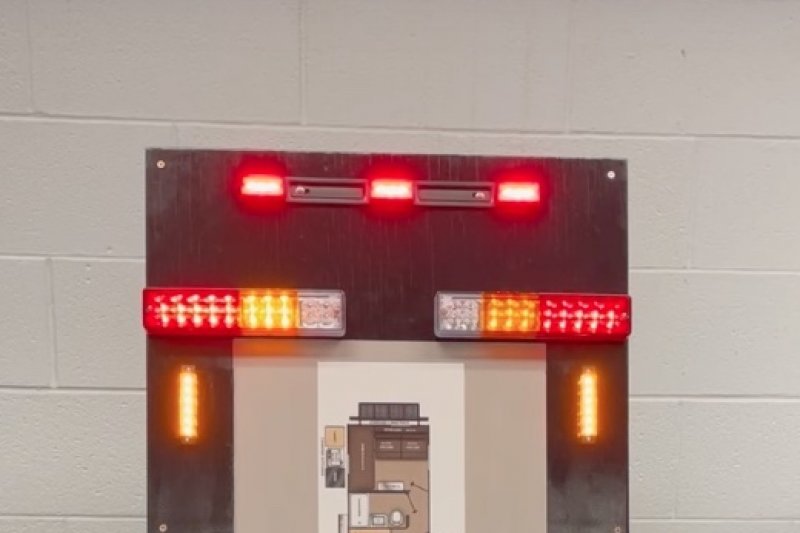
In the last two years, the ECE department has executed 34 Senior Design projects. The following companies and projects were involved this past year: Rockwell Collins: Students designed, built, and tested a Vivaldi broadband antenna for use in mobile satellite communications. Consumers Energy: Student teams developed the protective relaying specifications for the transformer banks, buses, and lines at a major substation and at the remote ends of the lines. American Electric Power: Students completed a voltage fluctuation analysis for synchronous generators to assess how neighboring loads are affected in a distributed power network. Johnson Controls: Students developed hardware and software to implement pulse width modulation in automotive power seats in order to minimize power use and electrical and acoustic noise. Mercury Marine: Students developed a novel voltage rectifier and regulator for outboard motors. Bechtel: Students developed a wireless tool tracking and power usage system for applications on large construction sites. Visteon: Students developed a remote system to acquire a wide range of performance data from vehicles. Dow: Students constructed a detailed simulation of an industrial grade chemical reactor to be implemented in a new plant under construction. Unisys: Students designed and optimized a DRAM controller to satisfy interface requirements with specific new technologies. Functional requirements included data refresh, request management, and state tracking. Kimberly-Clark: Students designed and tested an infrared measurement and computer control system to track temperatures on a production line. Bosch: Students built and tested an acquisition system for braking data during operation of an automobile. Via Systems: Students designed key elements of an automated hydraulic sled decelerator. General Motors: Students designed mechanical and electrical hardware for a steer-by-wire system. They implemented a 42V fault-tolerant power generation and distribution system. For the pdf version of The Circuit (5 Mb file size) Click here to download |
Department of Electrical
and Computer Engineering We at the Department of Electrical and Computer Engineering are interested in keeping in contact with our alumni. Please update us on any recent developments in your life. Click here to open a separate page for printing. Name _________________________________________________________ Can we include this information in a future newsletter (Yes or No)? _____ If you would like to make a donation to the Department of Electrical and Computer Engineering, please make your check payable to: " Michigan Tech Fund — Department of Electrical and Computer Engineering" Please return this form and your donation to: Department of Electrical and
Computer Engineering Back to ECE News |